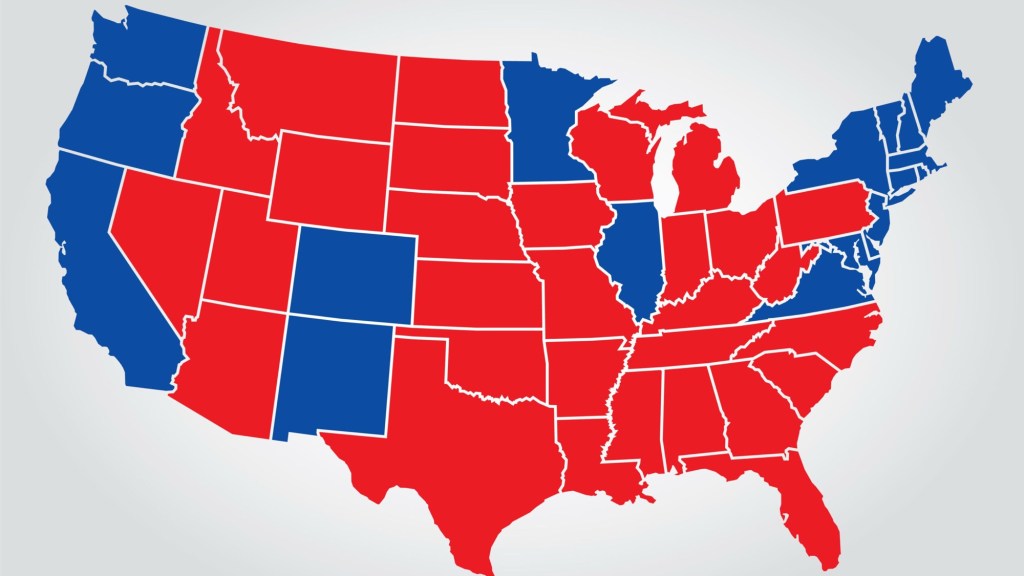
I preface this blog post by stating up front that the terms “blue state” and “red state” are just another way to label states with populations that are more conservative-minded (red) or liberal-minded (blue) and tend to consistently vote based upon these ideological tendencies (Democratic blue or Republican red).
My motivation for writing this post came from watching YouTube political content creator David Pakman’s video below regarding MAGA (Donald Trump slogan “Make America Great Again”) and its “big lie” covering up the failures of so-called red states due to their antiquated and regressive government policies.
The video speaks for itself, but to summarize and to highlight my own point of view on the subject, David Pakman’s assertion is that conservative policies in red states are yielding deleterious effects on the economies in said states. Policies like abortion bans and rejecting Medicaid expansion are causing younger, college-educated citizens to leave red states, resulting in an older and/or less-educated workforce in those red states that is more dependent upon federal assistance, ironically funded by taxpayers dollars coming from wealthier blue states, despite the rhetoric preaching rugged individualism and self-sufficiency from the federal government.
There is much truth to what Pakman says in his video. Red states do in fact receive more federal money back from Washington DC than they send to Washington DC, whereas blues states often send more money than they receive back from the federal government.
https://www.pbs.org/newshour/show/red-states-depend-distrust-government
In 2019, seven of the top ten states with the highest murder rates were so-called red states that voted for Trump in 2020.
While I disagree that politics, in and of itself, has a major impact upon these statistical trends, I think that the political attitudes prevalent in some states plays a significant role in these outcomes.
You are far better off living in an area where the population is better educated and where there are more opportunities for diverse and meaningful employment than you are in areas that are less educated and where employment opportunities are less abundant or accessible to the populace.
It is difficult to dispute that it is far more expensive to live in California or New York than it is to live in Mississippi or Louisiana. However, it is equally difficult to dispute that if you are an educated, highly skilled person, you are better off living California than you would be living in Louisiana.
The Merva-Fowles study validates this fact.
https://content.csbs.utah.edu/~fowles/crime.pdf
According to this study, income inequality, or at least the perception of it, is a significant contributor to property crime in particular and violent crime in general. A “blue city” in an otherwise red state with a higher population will naturally have more income inequality, and therefore more crime, because there are more people in the blue city. However, the lack of economic opportunity and its effect on crime and poverty prevalent in many so-called red states cannot be dismissed simply because there are more people living in blue states. The percentage of people in poverty in red states is alarmingly high compared to blue states.
https://gppreview.com/2020/02/21/growing-divide-red-states-vs-blue-states/
While I can make an argument against David Pakman’s assertions, I’d be hard-pressed to do so.
-The Rational Ram
 The Rational Ram