Why both sides misunderstand Sexual Market Value—and what it actually is.
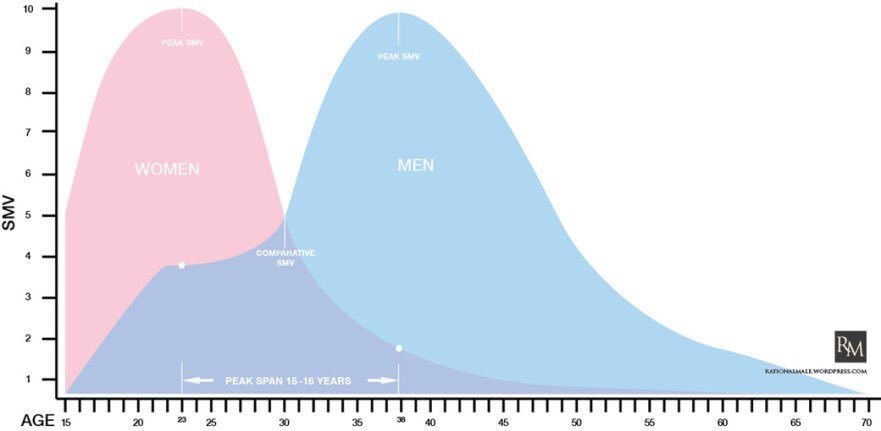
The manosphere treats SMV like a stock chart (see the image above).
Feminists pretend it doesn’t exist.
Both are wrong.
Sexual Market Value (SMV) is real—but not the way anybody online describes it.
Let’s tear down the myths and build the real model.
1. What the Manosphere Thinks SMV Is
The manosphere reduces SMV to a crude formula:
Men’s SMV = money + status + power + muscles
Women’s SMV = youth + beauty + fertility
That’s it.
A brutally simplistic, evolutionary-cartoon version of human attraction.
This framework leads to the usual talking points:
“Women peak at 22.”
“Men peak at 40.”
“Men age like wine; women age like milk.”
“Hypergamy means women only want the top 10%.”
“Men must become high-value; women just have to be born.”
It’s not just wrong—it’s incomplete to the point of parody.
People don’t date in a vacuum. They date within a culture, an economy, and a psychological ecosystem.
2. What Feminists Think SMV Is
The feminist corner tries to counter by saying:
“SMV is a misogynistic social construct.”
“There’s no sexual marketplace.”
“Everyone is equally attractive.”
“Preference is oppression.”
“Age shouldn’t matter.”
Like the manosphere narratives, these narratives also collapse under the weight of real-world behavior.
People are not equally attractive.
People do rank potential partners.
Preferences do exist.
Sexual competition is real.
Attraction is not a democracy.
Denying biological and psychological patterns doesn’t make them go away or render them irrelevant.
3. Reality: SMV Is a Dynamic, Multi-Dimensional Marketplace
Here’s the truth…
SMV is not purely biological and not purely ideological—it’s socioeconomic, psychological, and contextual.
It’s influenced by:
- Culture
- Geography
- Age
- Trauma
- Personality
- Self-esteem
- Lifestyle
- Socioeconomic status
- Community norms
- Online ecosystems
- Relationship goals
- Personal history
A 22-year-old woman who is a “6” in LA is an “8” in the Midwest and a “9” in rural Montana.
A 40-year-old man making $120k is considered as having “high SMV” in some cities (like Omaha, Nebraska), but invisible in others (like NYC).
A high-income man with zero social skills has lower romantic value than a charismatic middle-income man.
A conventionally attractive woman with chaotic behavior patterns loses value fast.
SMV is not a fixed, unchanging number.
It’s a value range based on environment, context, and individual factors.
4. The Biological Kernel: Why People Believe the Extremes
SMV does have roots in evolution:
Women historically selected men for resourcefulness, stability, and competence.
Men historically selected women for youth, health, and reproductive potential.
These tendencies still influence modern attraction patterns.
But here’s what both sides tend to ignore…
Women don’t just want “resources.” They want resourcefulness.
Money is replaceable. Character isn’t.
Men don’t just want “youth.” They want feminine energy + compatibility + emotional stability.
Youth is only one small factor.
Evolution built the instincts. Society modifies the expression.
5. The Manosphere’s Biggest SMV Mistake
The manosphere confuses sexual attention with romantic value.
They think:
If a woman gets 500 DMs → she’s high SMV
If a man gets fewer options → he’s low SMV
If a man gets laid a lot → he’s high SMV
If a woman gets laid a lot → she’s low SMV
But here’s the truth:
Sexual desirability ≠ Long-term desirability.
A man with lots of options is often attractive physically—but that doesn’t guarantee he has good character.
A woman with lots of options on Instagram is often attractive visually—but that might not translate to her being desirable relationally.
“Sigmas” (men who are “lone wolves, “ a man who is independent, self-reliant, and often prefers solitude over social interactions), introverts, stable men, and balanced women often have fewer options—but higher long-term value.
6. The Feminists’ Biggest SMV Mistake
Feminist spaces tend to insist that:
“Attraction is subjective.”
“Everyone is equally desirable.”
“Preferences are discriminatory.”
This creates two problems:
1. It pressures people not to acknowledge their real desires
Men can’t admit they like femininity or youthfulness.
Women can’t admit they like taller, stronger, more capable men.
2. It encourages delusion
If all men are attractive and all women are queens, why is dating such a disaster?
The obvious answer is because pretending SMV doesn’t exist just forces people to discover it through disappointment.
7. The Real Model: SMV Has Three Layers
Layer 1: Biological SMV
- Attractiveness
- Health
- Vitality
- Fertility cues
- Physical fitness
- Youthfulness (what many men vet women for)
- Competence signals (what many women vet men for)
Layer 2: Economic & Social SMV
- Income
- Lifestyle
- Socioeconomic status
- Social circles
- Reputation
- Cultural norms
- Geography
Layer 3: Psychological & Relational SMV
This is the one both sides ignore—and it determines long-term success.
- Emotional stability
- Attachment style
- Communication skills
- Trauma load
- Confidence
- Personality fit
- Integrity
- Discipline
- Maturity
Two people with identical “biological SMV” and a compatible “economic and social SMV” can have a wildly different, and much lower, relationship value because of differences between them at Layer 3.
This is why some “10s” are undateable and some “7s” can retain marriage-material mates effortlessly.
8. SMV Is Not Fixed—It Rises and Falls Across Life
The manosphere says women’s value drops sharply with age.
The feminist side says women get better with age.
Reality?
Both genders gain some value and lose some value as they age.
Women at 18–25: Highest biological SMV, lowest relational SMV
Women at 28–40: Lower biological SMV, higher relational SMV
Men at 18–25: Lowest relational SMV, lowest economic SMV
Men at 30–50: Peak relational + economic + emotional SMV
But again—context matters.
A 38-year-old woman with great fitness, maturity, femininity, and warmth can outperform a 24-year-old with chaos energy.
A 22-year-old man with direction and emotional intelligence can outperform a 35-year-old man with unresolved trauma.
9. So What Is SMV Really?
It is the perceived value you bring to a relationship at a particular moment in your life.
It’s not just your looks.
It’s not just your money.
It’s not just your age.
It’s the net sum of:
- Your stability
- Your character
- Your lifestyle
- Your emotional health
- Your ambition
- Your maturity
- Your compatibility
- Your behavior
- Your self-governance
- Your reputation
- Your life trajectory
SMV isn’t a number. It’s a pattern of various behavior signals and individual characteristics influenced by social and geographical factors.
Closing Thoughts 💭
The manosphere turns SMV into a scoreboard.
Feminists pretend it’s imaginary.
Both approaches make people miserable.
Reality?
SMV exists, but it’s far more complex than either side will ever admit.
It changes.
It’s contextual.
It’s psychological.
And it can be improved.
You are not stuck with the SMV you had at 20 or 30 or 40.
You rise or fall with your behavior, choices, lifestyle, emotional maturity, and trajectory.
SMV isn’t about beating the opposite sex.
It’s about becoming the version of yourself that attracts the partner that’s attracted to you.
-The Rational Ram
 The Rational Ram