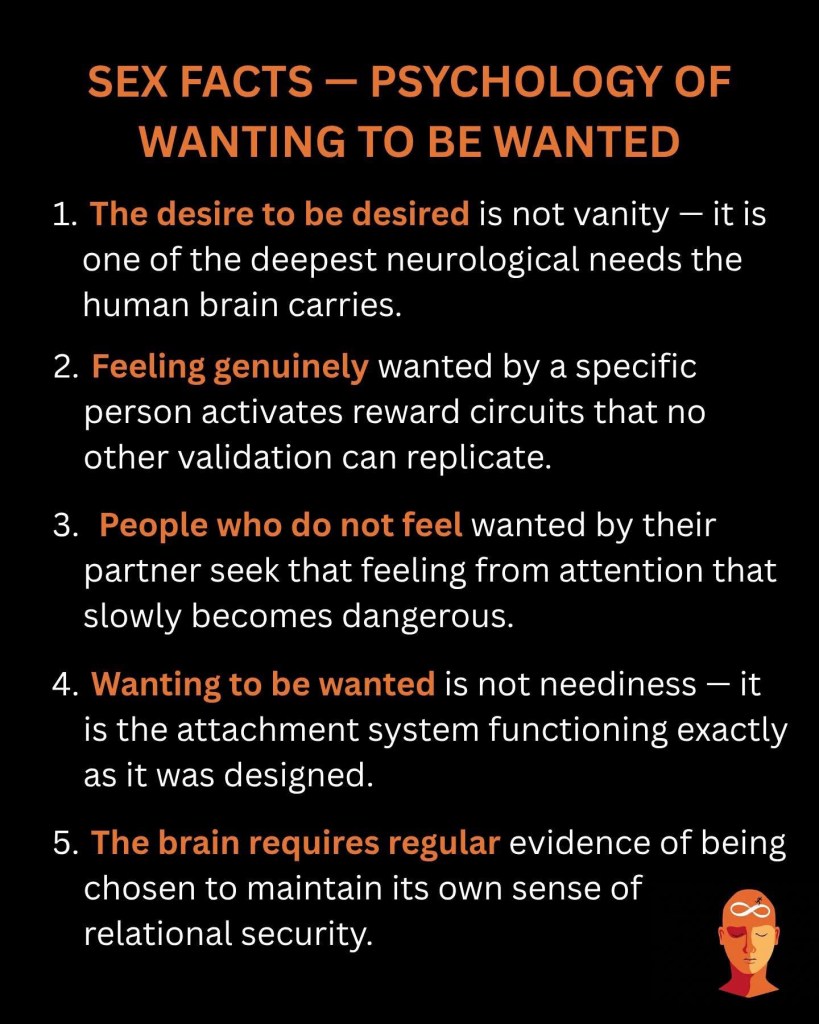
There’s a popular idea making the rounds of Facebook and probably other social media that the desire to be desired is one of the deepest needs hardwired into the human brain.
It sounds profound. It sounds scientific. It even feels true.
But like most things dressed up in certainty, it’s only partially right—and that distinction matters.
Let’s get something straight from the outset:
Wanting to be wanted is human.
Needing it to feel whole is a liability.
That’s the line most people never draw.
The Truth Beneath the Noise
Human beings are wired for connection. That part is not up for debate.
We form bonds. We seek belonging. We respond to affection and attention. When someone we value chooses us—genuinely, consistently—it feels good. It activates reward pathways in the brain, reinforces trust, and deepens attachment.
All of that is real.
But somewhere along the way, a subtle shift happens in how this truth gets interpreted.
It goes from:
“Connection matters.”
to:
“I need to feel desired to be okay.”
That’s where the problem begins.
The Dangerous Upgrade: Preference → Requirement
Wanting to be desired is a preference.
Needing to be desired is dependence.
And dependence—no matter how it’s dressed up—is fragile.
Because the moment your sense of worth is tied to someone else’s attention, you’ve outsourced control. You’ve handed over your internal stability to something you do not own.
That’s not romance. That’s exposure.
Attachment Isn’t the Same as Validation
Modern psychology often gets summarized poorly, and attachment theory is a prime example.
Yes, humans have attachment systems.
Yes, we benefit from feeling secure in relationships.
But security doesn’t come from constant reassurance or repeated proof that you’re “chosen.”
It comes from:
- consistency
- trust
- emotional regulation
- and, most importantly, self-possession
If someone needs constant evidence that they’re wanted, that’s not the brain “functioning as designed.”
That’s the brain compensating.
What Actually Makes Someone Dangerous to Themselves
You’ll often hear that people who don’t feel wanted go looking for attention in risky ways.
Sometimes that’s true.
But just as often, something else happens.
Some people:
- build discipline
- focus on purpose
- develop independence
- and stop negotiating their value altogether
In other words, they stop chasing validation and start building identity.
That’s not deprivation. That’s evolution.
The Real Power Move
There’s a quiet shift that happens when you no longer need to be desired.
You still appreciate it.
You still enjoy it.
You still respond to it.
But you are no longer driven by it.
And that changes everything.
Because now:
- You choose relationships instead of clinging to them
- You evaluate attention instead of chasing it
- You walk away from misalignment without hesitation
You’re no longer asking, “Do they want me?”
You’re asking, “Does this align with who I am?”
Ownership Over Optimization
There’s a phrase I’ve come back to often:
Ownership over optimization.
You don’t need to optimize yourself to be wanted.
You need to own yourself so that being wanted is a byproduct—not the goal.
Because here’s the reality most people avoid:
The people who are most desired are usually the ones who don’t depend on it.
Final Thought
Wanting to be wanted is natural.
But if you build your life around that desire, you’ll always be negotiating from a position of need.
Build your life around alignment instead.
Because when you know who you are—and you operate from that place—being wanted stops being a requirement…
…and becomes a reflection.
-The Rational Ram

