(And the Other 95% Get Angry When You Point It Out)
Let’s be honest.
Most people don’t think.
They repeat.
They download opinions from TikTok, Twitter, podcasts, group chats, and trauma porn… then call it “having a mind of their own.”
That’s not intelligence.
That’s parroting with confidence.
If thinking were common, we wouldn’t constantly observe people experiencing the same failures, foibles, outcomes and behaviors over and over again.
For example:
- The same failed relationships
- The same money problems
- The same political talking points
- The same excuses dressed up as “my truth”
But we do.
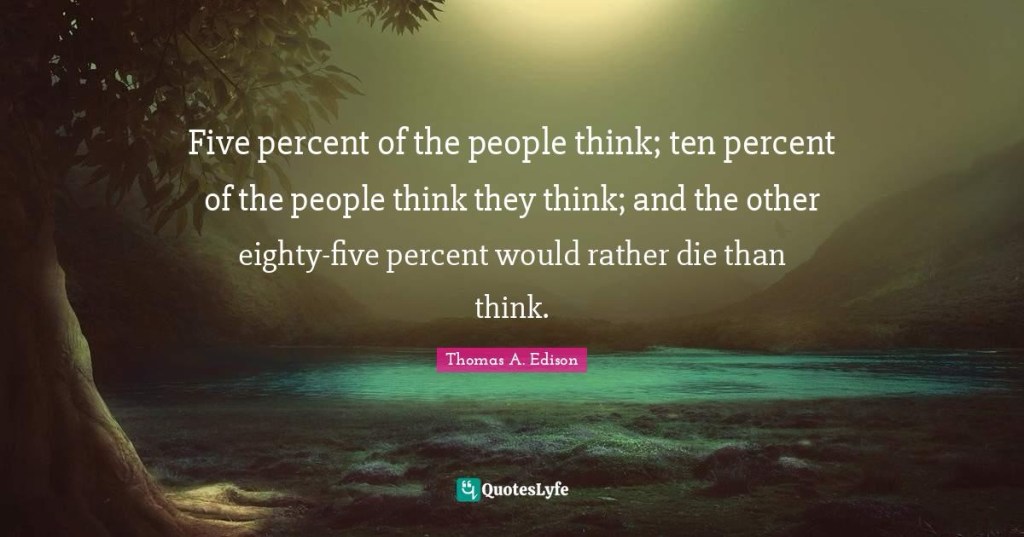
Because only about 5% of people actually engage their brains and think — and the other 95% defend beliefs they’ve never interrogated.
I know the percentages are anecdotal and rhetorical rather than scientific, but the empirical evidence suggests that the percentages are not just a random guess.
That said, I don’t mean to imply that 95% of people aren’t thinking at all or incorrectly, per se.
I am suggesting that most people spend far more time defending their beliefs than honestly examining them with an open mind.
Let me further define what I mean in this post by “thinking.”
Thinking is the willingness to examine your own beliefs, test them against reality, and revise them when the evidence warrants it.
Thinking doesn’t guarantee you’ll reach the correct conclusion. However, it guarantees only that you’re willing to question your own conclusions, which, in my experience, is a healthier way to approach life.
Thinking Often Conflicts With Ego
Real thinking feels like a personal attack on ourselves. It often:
- Exposes bad decisions
- Destroys comforting narratives
- Removes the ability to blame “the system”
- Forces accountability with no applause
That’s why most people avoid deep, meaningful thinking.
They don’t want truth.
They want emotional anesthesia.
So they choose:
- Vibes over evidence
- Identity over outcomes
- Consensus over correctness
- Feeling right over being right
And then they wonder why nothing in their lives ever changes for the better.
The Average Person Is Programmed, Not Reflective
Most people:
- Believe what rewards them socially
- Defend ideas that protect their identity
- Attack information that threatens their excuses
- Confuse outrage with insight
They don’t ask:
“Is this accurate?”
They ask:
“Who agrees with me?”
That’s not thinking.
That’s tribal obedience with an attitude problem.
Understanding trumps agreement because the former breeds empathy, the latter contempt when agreement is not reached.
Why Thinkers Get Attacked
Notice who gets labeled:
- “Negative”
- “Arrogant”
- “Cold”
- “Problematic”
- “Red-pill / blue-pill / woke / toxic” (pick your poison)
It’s never because the person leveling the label is wrong.
It’s because thinking breaks their illusions.
People hate mirrors more than lies.
A thinker forces you to see:
- Your patterns
- Your hypocrisy
- Your self-sabotage
- The gap between your values and your behavior
Most people would rather shatter the mirror than reflect and make meaningful changes.
The 95% Confuse Emotion With Intelligence
If your beliefs collapses the moment someone challenges them, you weren’t thinking — you were just believing.
If disagreement feels like a personal attack, you don’t have principles — you have an unhealthy emotional attachment to ideology or dogma.
If facts offend you, you are not evolved. You’re fragile.
Real thinkers can hear opposing views without melting down.
Everyone else screams “toxic” and blocks.
The Truth No One Likes To Face
Most people don’t fail because life is hard.
They fail because they refuse to:
- Question themselves
- Abandon bad narratives
- Accept that they are living uncomfortable patterns
- Trade short-term comfort for long-term control
Thinking would force change.
And change would expose how much time they’ve wasted.
So they stay loud, falsely certain, and perpetually stuck.
The Silent Advantage of the 5%
The few who think:
- Exit bad relationships early
- Don’t argue online for identity points
- Choose partners based on behavior, not fantasy
- Build leverage instead of excuses
- Live quieter, cleaner, less dramatic lives
They don’t need validation.
They already validated their beliefs against reality, and leave room for optionality and change when opportunity and circumstances dictate that change is necessary.
Final Thoughts 💭
If this post made you angry, congratulations — you just proved the point.
Thinking doesn’t always feel like affirmation.
It feels uncomfortable most of the time, but ultimately liberating.
And most people would rather stay comfortable than become free.
📋 Signs You’re Not Thinking
(Be honest. Or don’t. It won’t change the result.)
You Might Not Be Thinking If…
⛔ You repeat talking points but can’t explain why they work in real life
⛔ You label disagreement as “hate,” “toxicity,” or “ignorance”
⛔ Your beliefs perfectly match your social circle
⛔ You get emotional before you get curious
⛔ You block people instead of refining your argument
⛔ You confuse confidence with correctness
⛔ You cherry-pick examples that protect your ego
⛔ You trust intentions more than outcomes
⛔ You avoid data that threatens your identity
⛔ You mistake being offended for being right
⛔ You outsource thinking to influencers, gurus, or ideology
⛔ You say “that’s just how I am” instead of changing your behavior
⛔ You’d rather win an argument than fix your life
⛔ You’ve never updated a core belief in years
Final Gut Check
If you read this checklist and thought:
“This is about them”
…it’s probably about you.
Thinking starts the moment defensiveness ends.
Most people never get there.
-The Rational Ram
 The Rational Ram