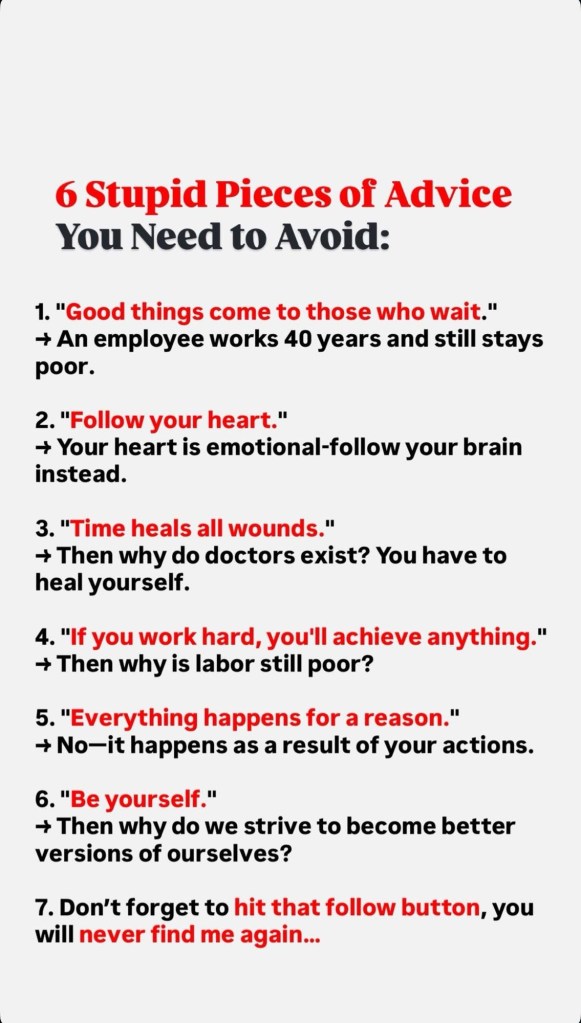
Every so often, a social media post makes the rounds claiming to expose “bad advice” we’ve all heard before:
- “Good things come to those who wait.”
- “Follow your heart.”
- “Time heals all wounds.”
- “Work hard and you’ll achieve anything.”
- “Everything happens for a reason.”
- “Be yourself.”
At first glance, the Facebook graphic that opens this blog post feels refreshing—almost rebellious. Like someone is finally telling the truth.
But look closer, and something is off.
This graphic doesn’t actually dismantle bad advice. It dismantles literal interpretations of simplified ideas.
That’s a very different thing.
The Real Issue: Literal Thinking in a Nuanced World
Most advice is not meant to be taken at face value.
It’s shorthand.
A compressed idea.
A principle—not a prescription.
The problem isn’t the advice.
The problem is treating it like a rigid rule instead of a flexible tool.
1. Patience vs Passivity
“Good things come to those who wait.”
If you interpret that as do nothing and hope, then yes—it’s terrible advice.
But that’s not what it means.
Patience is not passive. It’s disciplined waiting after taking measured, deliberate action.
Rational version:
Good things come to those who act consistently and wait intelligently.
2. Emotion vs Direction
“Follow your heart.”
Taken literally, this leads to impulsive decisions and unnecessary chaos.
But ignoring emotion entirely leads to something worse: a life that looks good on paper but feels empty.
Rational version:
Let your heart choose the direction. Let your mind choose the method.
3. Time vs Effort
“Time heals all wounds.”
Time alone does nothing.
But time combined with effort, reflection, and intentional action? That’s where healing lives.
Rational version:
Time gives you the opportunity to heal. What you do with it determines the outcome.
4. Hard Work vs Strategic Work
“If you work hard, you’ll achieve anything.”
This one deserves more brutally honest scrutiny.
Hard work is necessary—but hard work alone is not sufficient.
Plenty of people work hard in the wrong direction, in the wrong environment, or without leverage.
Rational version:
Work hard on the right things, in the right environment, with the right strategy.
5. Meaning vs Reality
“Everything happens for a reason.”
Not exactly.
Some things happen because of your choices.
Some happen because of others.
Some happen because life is unpredictable.
But here’s the key…
Meaning is something you assign—not something guaranteed.
Rational version:
Not everything happens for a reason—but you can choose what it means.
6. Authenticity vs Stagnation
“Be yourself.”
Critics hear this and think it means stay exactly as you are.
That’s not authenticity—that’s stagnation.
Rational version:
Be your authentic self—and refine it over time.
The Pattern You Should Notice
Each piece of advice fails only when:
- It’s taken literally
- It’s applied without context
- It replaces thinking with blind emotion.
That’s the common thread.
The Rational Ram Perspective
Advice isn’t meant to absolve you of careful thought.
It’s meant to:
- point you in a direction
- simplify complexity
- give you a starting framework
From there, you do the work.
You test it.
You adjust it.
You align it with your life.
Final Thought 💭
There’s a growing trend of dismissing simple wisdom as “stupid.”
But most of that wisdom has survived the test of time for a reason.
Real skill isn’t developed or exercised by rejecting sound advice, even wrapped in simplistic language.
It’s knowing how to interpret it.
And more importantly…
Knowing when it applies to you.
Rational thinking isn’t about rejecting ideas.
It’s about refining them until they align with reality—and with your life.
-The Rational Ram

