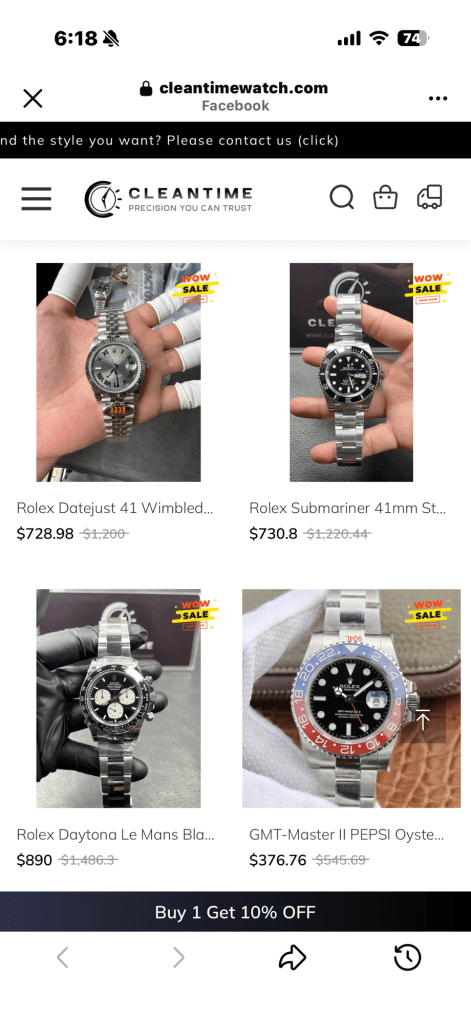
A Rolex for $700 isn’t a deal.
It’s a test—and most people fail it.
You don’t have to be naive to get fooled anymore.
That’s the part most people don’t understand.
There was a time when fake watches were obvious—lightweight, poorly finished, laughably bad.
Today?
Some of these “clones” are engineered well enough to pass a casual inspection, especially through a phone screen.
And that’s where the danger lives.
Not with experts.
Not with seasoned collectors.
But with regular, intelligent people who simply don’t know what they don’t know.
The Illusion of the $700 Rolex
Scroll through social media long enough and you’ll see ads just like the screenshot that opens this post:
- A Rolex Submariner for $730 (a stainless steel Sub with no date complication is $10,050 retail)
- A GMT-Master II for under $400 (starts at $12,000 retail)
- “WOW SALE” banners and countdown timers
It looks real.
It feels real.
It’s priced just high enough to seem plausible… and just low enough to feel like a win.
And that’s the trap.
Because the question isn’t:
“Could this be a good deal?”
The real question is:
“Why would something that reliably sells for $10,000+ suddenly be available for $700?”
There is only one answer.
Why Smart People Get Caught
This isn’t about intelligence. It’s about psychology.
1. Price Anchoring
When you know something is expensive, your brain looks for ways to justify a lower price.
“Maybe this is wholesale.”
“Maybe it’s direct from the source.”
“Maybe I just found a deal.”
You didn’t. You found a story.
2. Visual Confidence
Modern clones are designed to win one battle:
The glance test.
- Correct logos
- Proper dial layouts
- Convincing proportions
On a phone screen, that’s enough.
What you don’t see:
- Movement quality
- Material integrity
- Long-term durability
3. Social Proof Theater
These sites are built to feel legitimate:
- Clean layouts
- Fake reviews
- “Limited time” urgency
- Ads on platforms you already trust
It’s not about deception alone.
It’s about comfort.
The Real Cost Isn’t the Money
Let’s say someone buys one.
They don’t just lose $700.
They lose:
- Confidence (“How did I miss that?”)
- Trust (in sellers, in the market)
- Meaning (especially if it was a gift)
That’s the part nobody advertises.
The Three Rules That Prevent 99% of Mistakes
You don’t need to become a watch expert.
You just need to follow three simple rules.
Rule #1
If it says “Rolex” and costs under a few thousand dollars… it’s fake.
No exceptions. No nuance. No loopholes.
Rule #2
Buy from authorized dealers or known, reputable sellers.
Not social media ads.
Not random websites.
Not “a guy who knows a guy.”
Rule #3
If it feels like a steal, it’s a setup.
Real luxury doesn’t go on clearance.
Why This Matters More Than Ever
We’re entering a time where:
- Fakes look better
- Ads are more targeted
- Buyers are more confident
Which means the gap between appearance and reality is shrinking.
And when that gap shrinks, more people fall in.
The Deeper Lesson
This isn’t really about watches.
It’s about alignment.
A watch that pretends to be something much more expensive creates a subtle tension:
You’re wearing something that looks valuable…
but isn’t what it claims to be.
And whether anyone else notices or not…
You will.
Final Thought
The goal isn’t to look like you own something valuable…
it’s to own something you don’t have to explain to anyone. Including yourself.
That’s the difference between collecting and pretending.
And once you understand that—the “$700 Rolex” doesn’t just look fake…
It feels unnecessary.
PSA
To reiterate the three simple rules:
Three simple rules. Memorize them.
- If it says “Rolex” and costs under a few thousand dollars—it’s fake.
- If you found it on social media—it’s suspect.
- If it feels like a steal—it’s a setup.
If you know someone who’s been tempted by a “too good to be true” watch—send this blog post to them.
Friends don’t let friends get hoodwinked.
-The Rational Ram

