There’s a moment in every watch enthusiast’s journey when conventional wisdom doesn’t add up anymore.
For me, it wasn’t a $10,000 watch that changed my perspective.
It was a ~$500 one ($485, to be precise).
The Expectation
Like most people who get into watches, I followed the usual path:
- Start with affordable pieces
- Learn the brands
- Understand mechanical vs quartz
- Gradually look “upmarket”
I did the research. I looked at the icons. I understood why brands like Rolex command the attention—and the prices—they do.
I wasn’t confused about what made a $10,000+ Rolex Submariner desirable.
But I was still asking a simple question:
Would owning one actually change my daily experience?
The Disruption
Then I bought a watch that had no business being as good as it is.
A JDM (Japanese Domestic Market) piece from Casio (yes, THAT Casio).
The Oceanus:
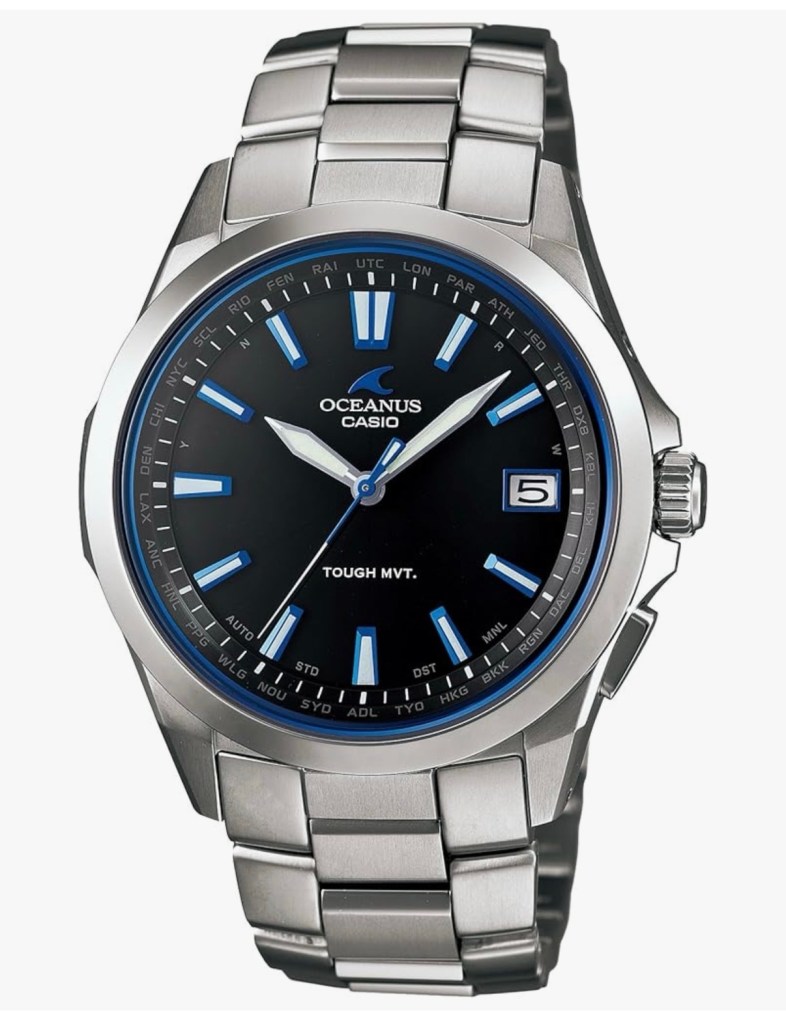
Titanium case.
Solar powered.
Radio-controlled timekeeping (Multi-Band 6).
Impeccable finishing for the price (Zaratsu polishing).
No waitlist. No games. No narrative.
Just… execution.
And here’s what I noticed:
I kept reaching for it.
Not occasionally. Not as a novelty.
Consistently.
The Problem That Created
This wasn’t supposed to happen.
Because according to the traditional hierarchy:
- A $500 watch is a stepping stone
- A $10,000 watch is the destination
But my behavior told a different story.
The Oceanus wasn’t:
- Less comfortable
- Less accurate
- Less useful
- Less reliable
In fact, in many ways, it was more of those things.
The $500 Oceanus gave me:
- Atomic accuracy
- Zero maintenance anxiety
- Daily comfort
The $10,000 Submariner would give me:
- Slightly better (subjective) finishing
- Brand recognition
- Emotional weight
Only one of those for the Submariner shows up in every use.
So I had to confront something most enthusiasts tend to avoid:
If a $500 watch already satisfies my daily needs…
what exactly am I paying for at $10,000?
The Honest Answer
You’re not paying for 20x performance.
You’re paying for:
- Brand history
- Mechanical craftsmanship
- Finishing at the margins
- Perceived exclusivity
- Emotional narrative
None of those are fake.
But they are intangibles.
And intangibles only matter if they align with what you personally value.
What I found with the Oceanus is that my lifelong grail watch, the Rolex Submariner, didn’t compare with the Oceanus in many respects that are important to me personally.
The Shift
That $500 watch didn’t make me dislike expensive watches.
It did something more important…
It removed the illusion that I needed one.
Before:
“I’ll eventually get there.”
After:
“I’ll only go there if it truly means something.”
That’s a completely different mindset.
The New Framework
I stopped asking:
- “Is this watch better?”
- “Is this worth the price?”
And started asking:
- “What role does this watch play?”
- “Does it add something I don’t already have?”
- “Is this aligned with how I actually live?”
That’s how watches went from…
A ladder to climb
…to a system to build.
The Unexpected Outcome
Ironically, that shift didn’t eliminate high-end watches from consideration.
It refined how I view their alignment within my collection.
A watch from Rolex—like an Explorer or a Submariner —still has a place in my future.
But not as:
- A reward for reaching a price tier
- A symbol to impress others
Instead, as:
- A milestone
- A personal marker
- A deliberate choice
Not something I chase.
Something I decide.
What the $500 Watch Really Taught Me
It wasn’t about price.
It was about clarity.
That watch showed me:
- Satisfaction doesn’t scale linearly with cost
- Daily experience matters more than brand narrative
- Capability often peaks far below luxury pricing
And most importantly:
You don’t need to spend more to enjoy watches more.
Final Thought
There’s nothing wrong with a $10,000 watch.
But there is something wrong with believing it’s the only way to “arrive.”
Sometimes, the watch that changes everything…
…is the one that proves you’ve already arrived.
For yourself.
-The Rational Ram

